2009

Introduction to Dams

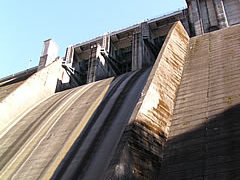
buttress dam

Buttress dams, also known as "support-wall dams," are dams that use concrete walls for support. There are only six such dams in Japan, and the Mitaki Dam (Tottori Prefecture), completed in 1937, was the last buttress dam in Japan. Because cement was an expensive material before World War II, buttress dams, which require less cement than gravity-type concrete dams, attracted attention and were constructed. However, as cement became less expensive, it was difficult to find engineers to work on the formwork, maintenance was not easy and costly, and there were durability problems.
Hyogo Prefecture Dam

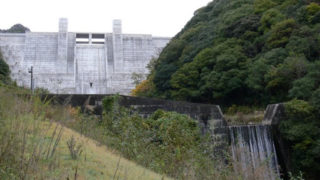
1519-Ishii Dam

This is a Hyogo Prefecture-operated flood control dam that also serves the purpose of recreation and has a gallery inside the embankment. I had done a little preliminary study of the dam beforehand, and was very curious to see a dam with "recreation" as its purpose. However, it seemed to fulfill its purpose, and there were quite a few people walking around. / Gravity concrete dam / 66.2m
"ta" column or row of the kana syllabary

dam curry

Dam curry is a type of curry in which the roux is made to resemble a dam lake and the rice portion is made to resemble an embankment. Like real dams, there are gravity, arch, and fill types. Kurobe Dam Curry at the rest house of Kurobe Dam (0848-Kurobe Dam) has a long history, but it was Sanshuya in Honjo, Sumida-ku, Tokyo, that introduced it to the media and spread it in earnest. This has led to an increase in the number of restaurants selling dam curry in various areas of Japan, including as a way to revitalize their towns.
"ta" column or row of the kana syllabary

Entertainers, TV personalities, and celebrities who like dams

Entertainers who like dams are entertainers and celebrities who have publicly declared their love of dams on TV programs. Tamori, Ken (L'arc~en~Ciel), Tomoya Nagase (TOKIO), Takeshi Nadagi, Yoshizumi Ishihara, Saya, Motohiro Takewaka (Buffalo Goro), Yanagibuson (The Plan 9), Masaya Toriguchi, Kaoru Sakura, Tani+1, Nobu Nakajima, Ryoko Imamura
Introduction to Dams

class 2 river

Second Class Rivers are rivers other than First Class Rivers as defined by the River Law, which are administered by the prefectural government (governor). The term "second class" does not indicate the size of the river, such as width, etc. Therefore, a river may be a first class river even if its size is small, or a second class river even if its size is large.
"ta" column or row of the kana syllabary

dam card

Dam cards are cards that the Ministry of Land, Infrastructure, Transport and Tourism and the Japan Water Agency began distributing in conjunction with the 2007 Forest and Lake Friendship Season event, mainly to raise awareness. Although they are the same size as so-called trading cards, they do not have a game element such as a match. Initially, dam cards were distributed only at dams managed by the Ministry of Land, Infrastructure, Transport and Tourism and the Japan Water Agency, but some prefectural dams have also begun to distribute the cards, and the number of dam cards is expanding.
"ta" column or row of the kana syllabary

conduit

A conduit is the channel from the overflow area downstream of the dam to the dam dam attenuator, and is used to ensure the proper flow of water from the flood discharge. There are several types of conduits, such as the levee downstream type often seen in gravity concrete dams, the chute type often seen in fill dams, and the tunnel type using tunnels.
"ta" column or row of the kana syllabary

Top (Crest)

The top end is the upper part of the dam embankment or levee. In many cases, dams dedicated to power generation are closed to the public, but in the case of multipurpose dams, the top of the dam may be open to visitors. Some multi-purpose dams open their topsides to visitors. In some cases, national highways are located above the topsides, and are referred to by enthusiasts as "national highways at the topsides. The width of the embankment is defined as 3 m or more based on the planned high water flow rate.
"ta" column or row of the kana syllabary

telemeter

A telemeter is [telemeter] a device that deciphers, indicates, or records measured quantities sent as electrical signals from a distant place (from Shinjirin Sanseido). Telemeters at dams mainly transmit measurement data from rain gauges and water level gauges to the management office. Based on the measured data, they are used for various gate operations and various warnings. Recently, there are also many cases where the measured data is distributed via the Internet.
"ta" column or row of the kana syllabary

Bank length

The crest length is the length of the dam embankment (top). In the case of a fill dam, the concrete portion of the flood discharge is not included, but the crest length tends to be longer than that of a gravity concrete dam or an arch dam.
alphabet

speak ill of

[The word "discharging" is a term used by dam enthusiasts to indicate that water is being discharged from a dam. Originally derived from the English word "discharge," meaning discharge. It was proposed by Masaki Hagiwara on Twitter. The word "dam" means "dam discharging," and "crest gate discharging.
"a" column or row of the kana syllabary

weir association

Weir-kai is a general term for a drinking party where dam maniacs have a drinking party. Dam mania term. It was (supposedly) proposed by Kamima in a chat or bulletin board (or maybe it was an e-mail) on Saki Miyajima's site (?). (or maybe it was an e-mail). The word "weir" can also be read as "en", so it was proposed as a combination of "banquet" and "weir party". There are variants such as "Oyankai" and "Daiyankai".
"a" column or row of the kana syllabary

damming (e.g. a pond)

Weir-bun" is a dam enthusiast term for "iron-bun," a term that indicates the passion level of railroad fans, and was established before dawn on November 29, 2009. The name "weir" is derived from the fact that it can also be read as "en. Kamima had also proposed "bone fraction," but after a Twitter exchange with Masaki Hagiwara, it was decided to use "weir fraction. Kamima also thought it was "sekibun," but since it is also hung with "shio-bun" (salt), we would like to recommend this one.
"ta" column or row of the kana syllabary

Dam volume

Embankment volume is the volume of the dam embankment. It is the sum of the materials that make up the dam. Structurally, rockfill dams tend to have larger embankment volumes. Therefore, as of November 2009, Gifu's Tokuyama Dam (1130-Tokuyama Dam) boasts the largest embankment volume among all types of dams in Japan.
"ta" column or row of the kana syllabary

Bank height

The embankment height is the height of the dam. It is the height from the foundation to the top of the dam. Because of its height from the foundation, some dams do not appear to be high from the outside. The height of a dam or a weir is mainly determined by this embankment height (see "Dam").
"ta" column or row of the kana syllabary

Hollow Gravity Concrete Dam

A hollow gravity concrete dam is a gravity concrete dam with a hollowed-out embankment. Compared to gravity-type concrete dams, hollow gravity-type concrete dams not only have the economic advantages of requiring less concrete placement and transportation costs, but also have the advantage of being more stable than gravity-type concrete dams because the surface of the hollow dam is wider than that of gravity-type concrete dams.
"ta" column or row of the kana syllabary

Reservoir area

The waterlogged area is the area of the dam lake that is always at full water level. It is the area enclosed by the line where the highest water level of the dam lake meets the shore. A large waterlogged area does not necessarily mean a large total storage capacity. Incidentally, the word "waterlogged" means "filled with water. The word "waterlogged" also means "filled to the brim with liquid or other substance.
Hyogo Prefecture Dam

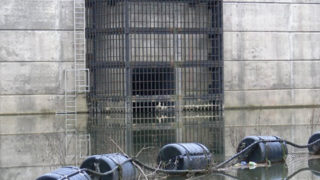
1507-Tenno dam

This is a perforated dam for flood control only, which does not store water. The orifice gate is actually visible in this photo. The orifice is located below the perforated gate. The orifice is higher than expected, so it does not seem that it does not store water at all. / Gravity Concrete Dam / 33.8m
"ta" column or row of the kana syllabary

multipurpose dam

A multi-purpose dam is a dam that serves multiple purposes in a single dam, among them flood control, power generation, industry, and irrigation. It is mainly defined by the "Act on Specified Multi-purpose Dams" enacted in 1957. Multi-purpose dams are broadly classified into specific multi-purpose dams managed by the Ministry of Land, Infrastructure, Transport and Tourism, and auxiliary multi-purpose dams managed by each prefecture.
"ta" column or row of the kana syllabary

Dam top elevation

The dam top elevation is the height from sea level to the top of the dam; as of November 2009, the highest dam in Japan is the Minamiami Dam (1,532 m) in Nagano Prefecture.
Copied title and URL